

I investigate how the earliest signs of life are preserved in the rock record and how microbial life could have originated in silica-rich hydrothermal environments (e.g., hot springs) on early Earth. To do this, I recreate hot‑spring conditions in the laboratory and test the preservation of specific organic compounds, including prebiotic molecules.
Reconstructing the emergence and nature of Earth’s first microbial ecosystems is central not only to understanding the history of life on Earth but also to the search for life beyond our planet.
Keywords
origin of life, biomarkers, hot springs, Archean, Precambrian
Researchinterest
I am interested in how the first microbes could have arisen in silica‑rich terrestrial hot springs on early Earth and how traces of that life—biosignatures such as chemical, structural, or isotopic clues—are preserved in rocks.
The origin of life fascinates people worldwide and researchers across many disciplines. It remains unclear whether life arrived on Earth via extraterrestrial material or whether the first cellular life emerged in Earth’s own environments. Multiple lines of evidence point to terrestrial hydrothermal settings, especially silica‑rich hot springs, as promising locations for life’s beginnings. These hot springs have existed throughout Earth’s history and today host diverse communities of Archaea and Bacteria. My research, therefore, focuses on how specific (prebiotic) organic compounds are preserved in such environments. I work with molecules like polycyclic aromatic hydrocarbons (PAHs) and with complex macromolecular organic films, conducting experiments at high temperatures and pressures with silica as the matrix. I study not only the preservation of these compounds but also the gases produced, the morphological features that form in the silica, isotopic signatures, and other indicators. This work is especially important because we lack rock samples from the first 600 million years of Earth’s history, the interval when life most likely began.


Currenttopic
PROTOS - The role of silica in the dawn of life on our planet
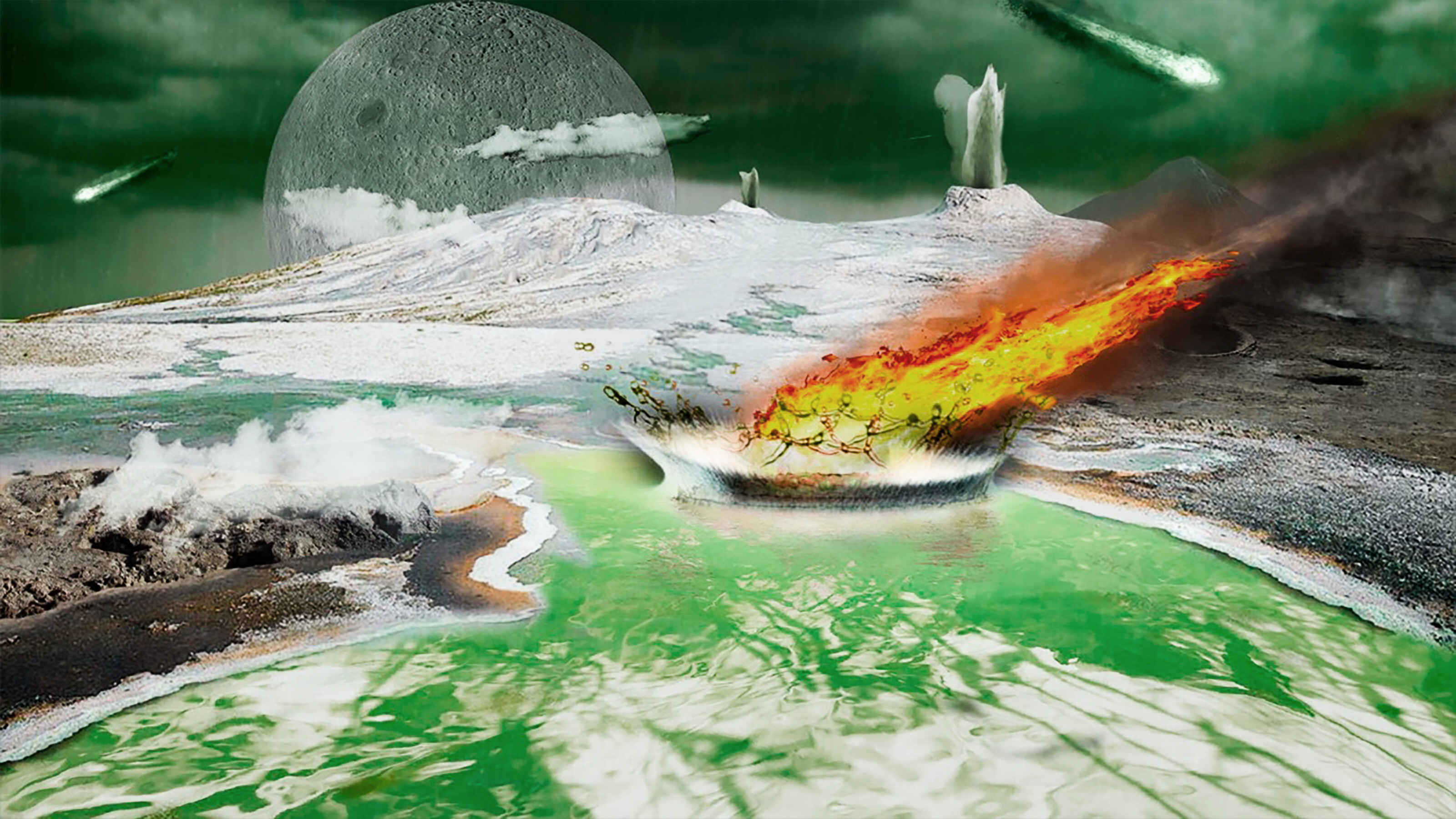
An artist’s vision of the Hadean era, the geochemical scenario of the origin of life that PROTOS will study / Artist: Lucas Chacón, CSIC
The first 600 million years of Earth’s history, known as the Hadean, are a mystery. No geological record exists. This enigma has driven scientists to computational models and sparse laboratory simulations to piece together our planet's earliest conditions and the origins of life. In this context, the ERC-funded PROTOS project aims to revolutionize our understanding of this primordial epoch. PROTOS focuses on recreating Hadean environments through innovative laboratory experiments. By scrutinizing reactions between water, gases, and ancient rock types, PROTOS focuses on the role of silica in the origins of early life-supporting habitats and the genesis and preservation of organic compounds crucial to life’s emergence. This pioneering effort promises to unveil critical insights into Earth’s infancy.