

Why do some groups of organisms evolve into many species, while evolution is much slower in other groups, places, or time periods? Why do some species go extinct, and why are some more resilient to major impacts or ecosystem changes? I study the ecology and evolution of biodiversity hotspots (e.g., Madagascar) to answer these questions.
I recently obtained a NWO-VIDI grant to study the botanical consequences of megafauna extinctions: what happens when your core seed disperser disappears?
Keywords
Angiosperms, diversification rates, plant-frugivore interactions, phylogenetic comparative methods, functional traits, megafauna
Researchinterest
I am interested in the evolution, adaptation and distribution of plant (angiosperm) diversity, and how mutualistic or antagonistic interaction between plants and animals (mainly vertebrates) have influenced this diversity.
Ultimately, biodiversity is the result of evolution - with often rapid and adaptive episodes that lead to an accumulation of diversity in certain places (e.g., islands, rainforests, biodiversity hotspots). Such evolutionary episodes are influenced by the interaction between the innovation of key traits and the environment (e.g., species interactions, climate change). Understanding what causes variation in species, genetic, functional and phylogenetic diversity is important for conservation and predicting what may happen to ecosystems in the future.
To study this, I travel to remote places (e.g., Madagascar, Indonesia) to search for particular species - often palms - and use their DNA to look back in evolutionary time. I also make use of our collections, to investigate the morphology of species. A large part of my work is behind my computer, where I use sophisticated modelling tools to understand general drivers of evolutionary and ecological patterns.


Currenttopics
A selection of the topics I am working on currently.
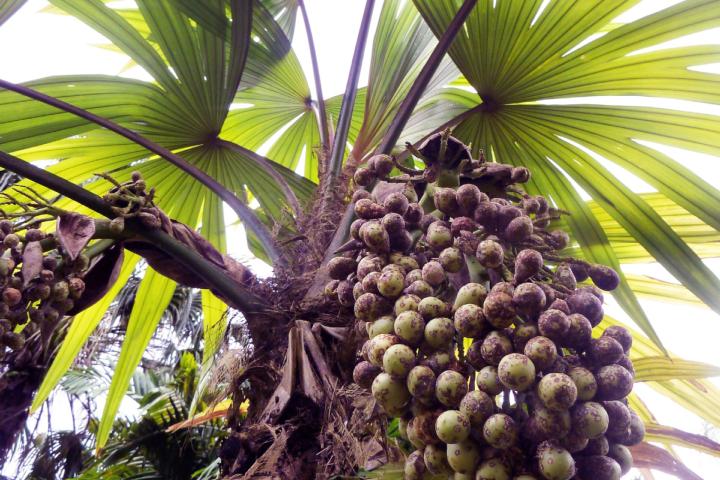
Megafauna and megafruit
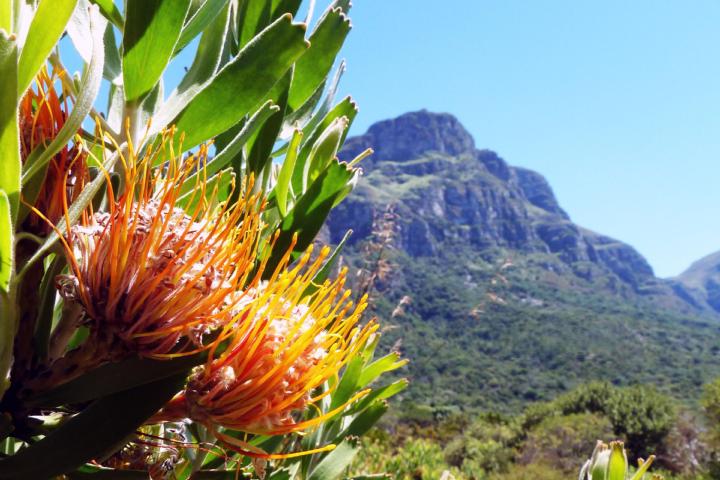
Trait evolution and convergence
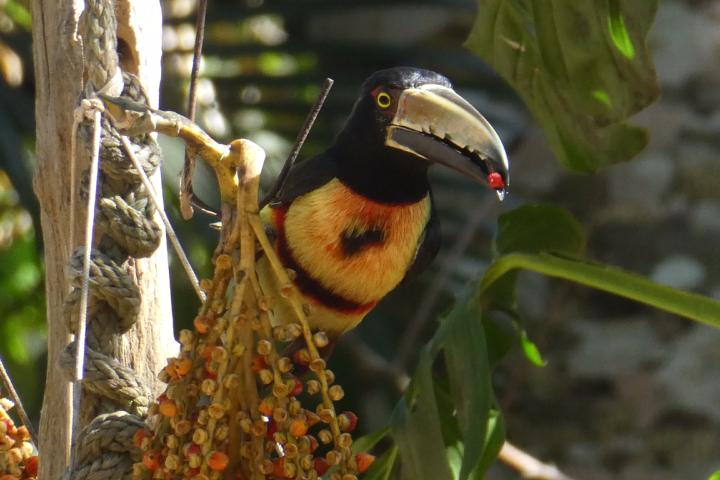
Plant-animal interactions
Keypublications
- Guerra, D., A. Cabral, M. Paetzolt, ... Onstein, RE 2025. Human-Induced Downsizing of Animal Communities Weakens Trait Matching Between Tropical Plants and Frugivores. Ecology Letters 28, no. 12: e70274. https://doi.org/10.1111/ele.70274.
- Alzate, A., Rozzi, R., Velasco, J.A. ... Onstein, RE Evolutionary age correlates with range size across plants and animals. Nat Commun 16, 7894 (2025). https://doi.org/10.1038/s41467-025-62124-y
- Onstein, R.E., Kissling W. D., and Linder H. P. (2022) The megaherbivore gap after the non-avian dinosaur extinctions modified trait evolution and diversification of tropical palms. Proc. R. Soc. B. 289:20212633. doi: org/10.1098/rspb.2021.2633
- Alzate, A. & Onstein, R.E. (2022) Understanding the relationship between dispersal and range size. Ecology Letters, 25, 2303– 2323. doi: org/10.1111/ele.14089
- Onstein, RE (2020) Darwin’s second ‘abominable mystery’: trait flexibility as the innovation leading to angiosperm diversity. New Phytologist 228: 1741-174. doi: 10.1111/nph.16294
- Onstein RE, Baker WJ, Couvreur TLP, Faurby S, Svenning JC, Kissling WD. (2017) Frugivory-related traits promote speciation of tropical palms. Nature Ecology & Evolution 1:1903–1911. doi: 10.1038/s41559-017-0348-7
For a complete list, see my google scholar page.
PhD and Postdocsupervision
Naturalis aims to be a breeding ground for national and international scientific talent. Therefore, PhD's and Postdocs have a special position in our organisation.
I supervise PhD students and mentor postdocs within Naturalis and Leiden University. Part of my core team are Saijing Liu, Daniel Guerra, Yuanshu Pu, Shweta Basnett, Rachel Souza Fereira and Adriana Alzate.

